LGBTQ+ Symbols Through History
Throughout history, LGBTQ+ individuals have used coded colours, items and jewellery to signal their identity to others in their community. Here are some of the symbols that have helped shape these communities over the centuries.
Violets
The violet as a symbol of sapphic love traces its roots back to the ancient Greek poet Sappho, who wrote tenderly of women exchanging garlands of violets. For centuries, sapphic women wore violets as a quiet signal to others in their community.
The modern revival of the violet as a sapphic symbol was cemented by the 1926 Broadway play The Captive by Édouard Bourdet. The story followed a secret lesbian relationship in which the exchange of violets played a pivotal romantic role. The play sparked massive public uproar, leading to protests and eventual censorship. In defiance, supporters of the play and women in the sapphic community began wearing violets on their lapels, or exchanging them as a covert way to signal their identity to one another.
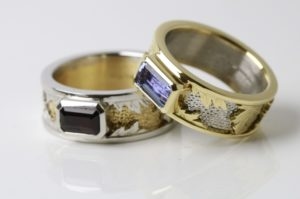
To wear this symbol in a more modern context, you could incorporate a purple sapphire, a violet tone tanzanite or a floral inspired pendant into your jewellery collection.
Green Carnations
The green carnation is one of the earliest and most famous symbols of gay identity. It emerged in late 19th-century England as a subtle but deliberate code among men who loved men.
Because homosexuality was illegal at the time, gay men relied on quiet signifiers to recognise one another. The vivid green colour, which does not occur naturally in carnations, served as a knowing, artificial in-joke: visible to those in the community, invisible to those outside it. Oscar Wilde famously encouraged a group of friends and admirers to wear green carnations to the opening night of Lady Windermere’s Fan in 1892, embedding the symbol in queer history.
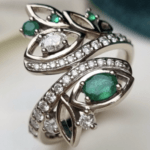
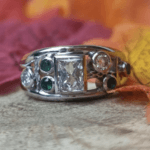
Again, due to the characteristic green, it would be easy to incorporate nods to this symbol in ones jewellery, perhaps with emerald stones or green lab diamonds.
The Black Ring
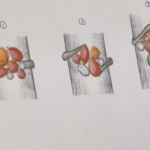
A black ring worn on the middle finger of the right hand is used by asexual people as a discreet way to signify their asexuality, a simple, personal marker of identity that requires no explanation to those who don’t know, but speaks clearly to those who do.
Pride Flags
Pride flags offer another source of deeply personal symbolism. The colours of a person’s associated flag can be translated beautifully into fine jewellery through coloured gemstones and diamonds. Wearing your flag’s colours is a way to carry your pride with you every day.
Made for You
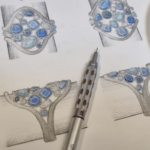
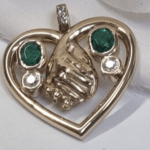
Our bespoke department has worked with many members of the LGBTQ+ community to bring their visions to life, symbolising their love through engagement rings, wedding bands, and pieces that tell their unique story.
Whoever you love, whoever you are and however you choose to express it, we at JFJ wish you a very happy Pride Month. 🌈