

What if, for Easter, instead of receiving a chocolate egg, you were given a beautifully crafted jewelled egg instead?
In 1885, Empress Maria Feodorovna received the first Fabergé Egg. It was commissioned by her husband, Russian tsar Aleksandr III , as a special Easter gift and created by the renowned jeweller Peter Carl Fabergé.
The egg was so admired that it began a remarkable royal tradition. Each year, a new egg was commissioned for Easter. Between 1885 and 1894, during the reign of Alexander III, ten imperial eggs were produced. When his son, Nicholas II of Russia, became emperor, he continued the tradition. From 1895 onward he commissioned two eggs each year, one for his mother, Maria Feodorovna, and one for his wife, Alexandra Feodorovna.
In total, fifty Imperial Fabergé eggs were created, each one uniquely designed and often containing a hidden surprise inside.
These legendary Easter eggs are widely regarded as the height of jewellery craftsmanship, signifying luxury in popular culture throughout history. Fabergé eggs are characterised by their unique design, opulent materials, and signature surprise at the center of each egg.
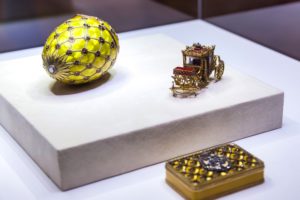
Even in the tiniest details, the eggs and their surprises show incredible technical precision, as well as being visually stunning. Pictured below is the Imperial Coronation egg. The egg is made from gold with translucent lime yellow guilloché enamel and is in reference to the robe worn by the Tsarina at her Coronation. Fitted inside the egg is a precise replica, less than 100 mm long, of the Imperial coach that carried the Tsarina Alexandra to her coronation.
Of the 52 known Fabergé eggs, only 46 have survived to the present day. Many of these eggs now belong to private collectors or are housed in museums across different countries, including three belonging to the Royal Collection in London. Many are considered lost with either the interior surprise being the only remaining element of the egg or sketches and pictures being the only evidence they existed.
These eggs have long inspired awe and admiration, and they continue to inspire us as well. One of our proudest moments as a business came when we were asked to create the Millennium Egg, presented each year at the Winchester BID Awards.
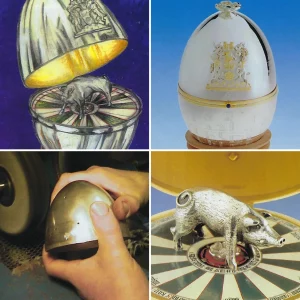
Created in 1999, the egg took more than 1,000 hours to craft, including 100 hours of intricate engraving alone, it opens to reveal a Hampshire Hog seated at the Round Table. Originally valued at £20,000 when it was completed, the piece is now worth considerably more.
Regardless of the mystery and circumstances surrounding these eggs, their true allure lies in the technical mastery they display, as well as the materials used to create them. Their wonder is not only rooted in their history but also in the way they demonstrate the extraordinary skill and artistry of the goldsmiths who created them, showing us craftsmanship that is both intricate and awe-inspiring.